Verified · sourced from period documents & USPTO patents
Broyhill Brasilia Walnut Credenza: Identification & Value
The Broyhill Brasilia Walnut Credenza is factory form 6140-13 from Broyhill's Brasilia line, introduced in 1962 and named for the modernist architecture of Brazil's capital. Its recessed arch pulls and colonnade-style panels — designed in-house at Broyhill and protected by 1963 U.S. design patents — are the line's signature. This page covers how to identify the credenza, what drives its value, and roughly how long comparable pieces take to sell.
Identify your piece
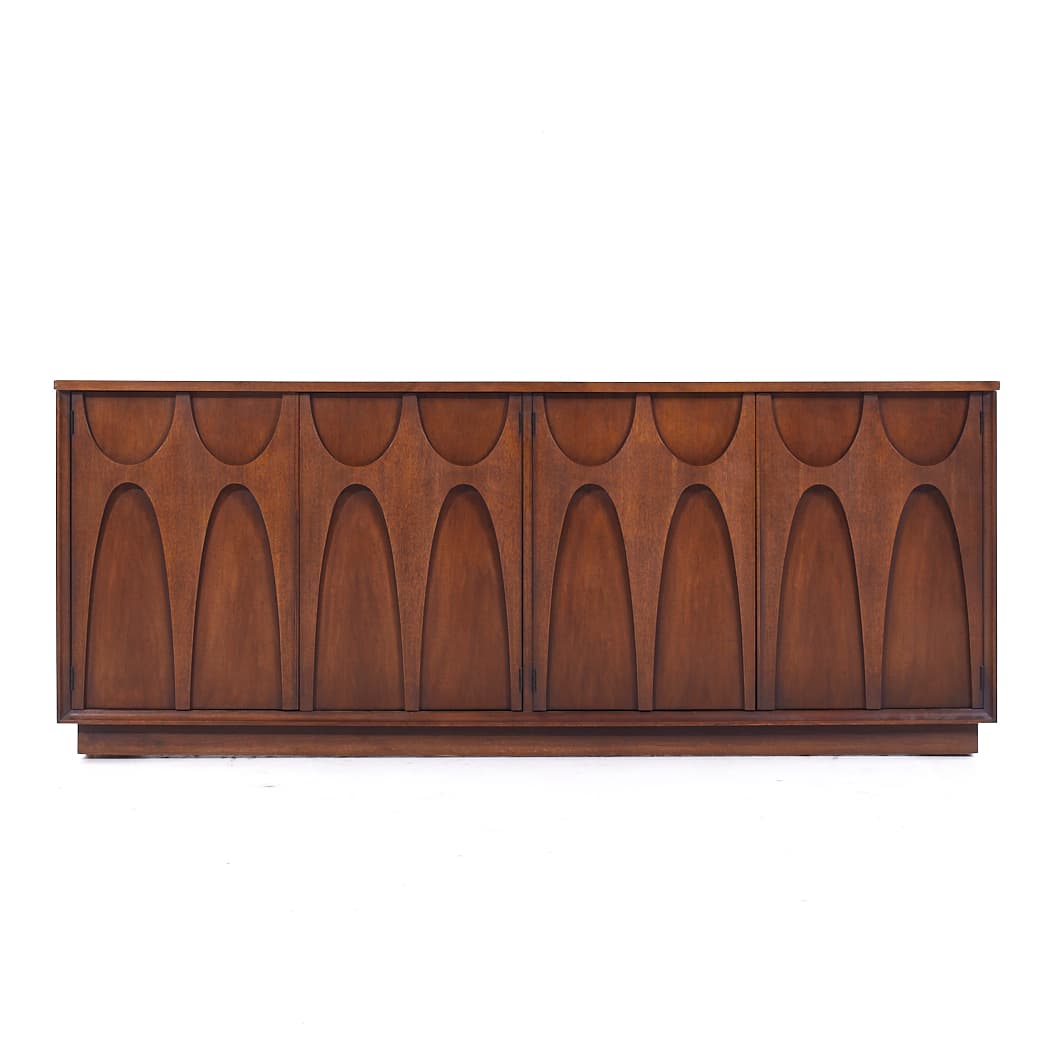
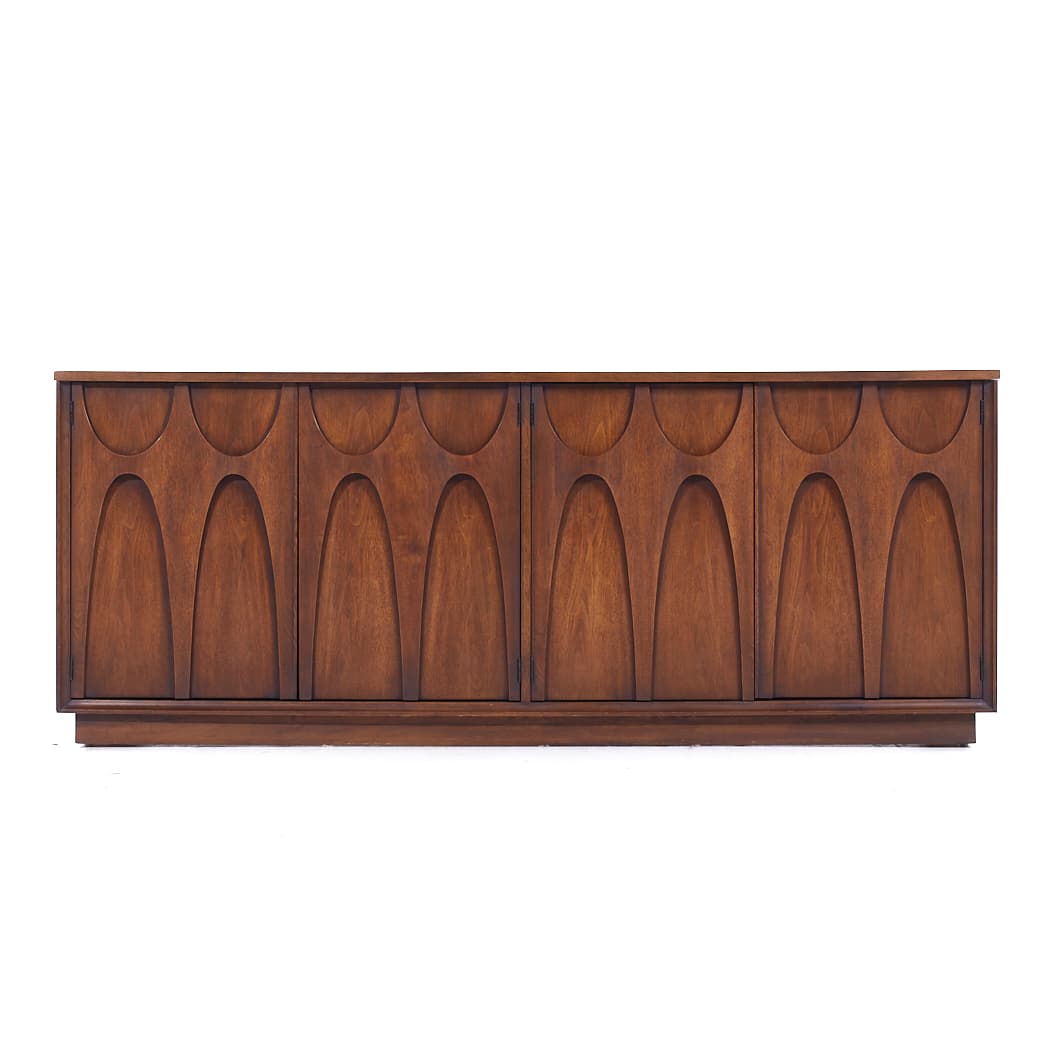
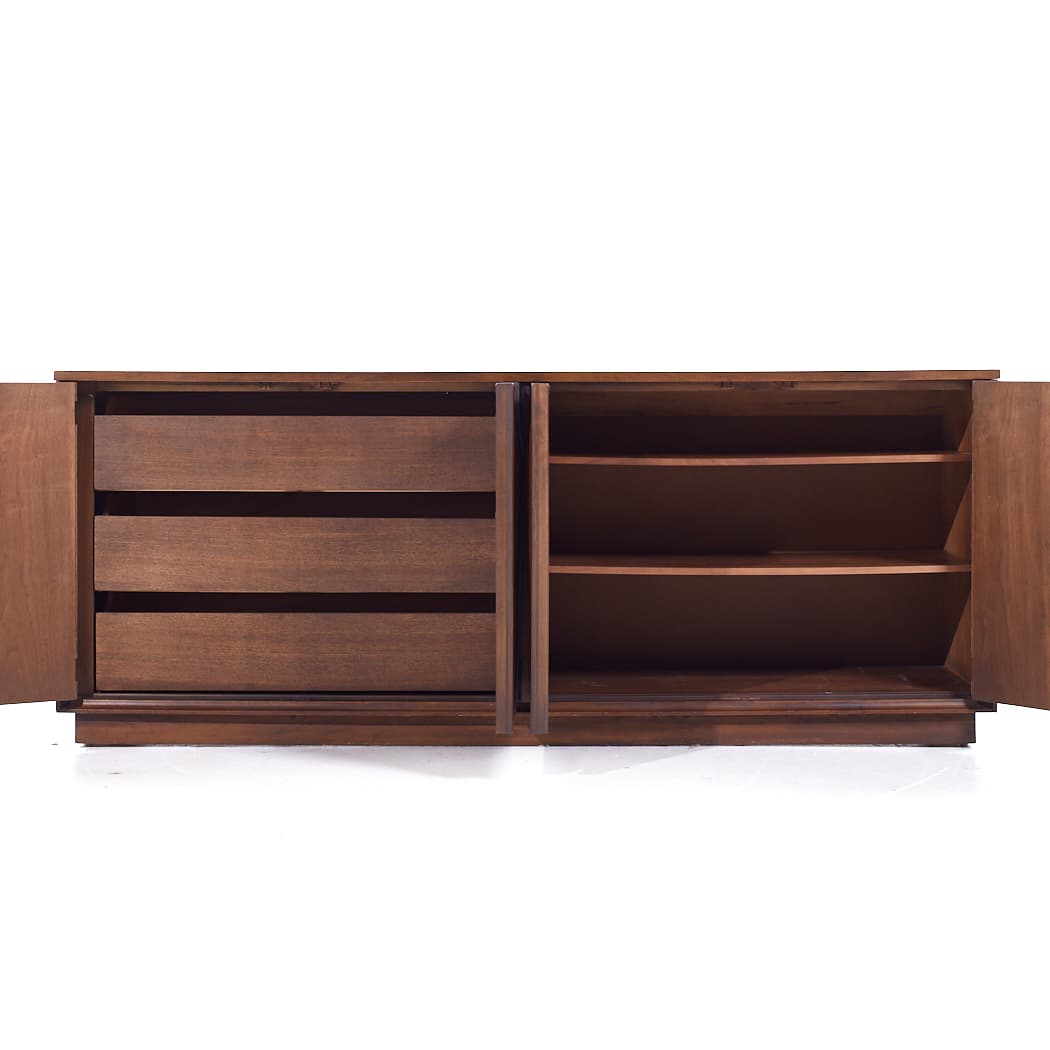
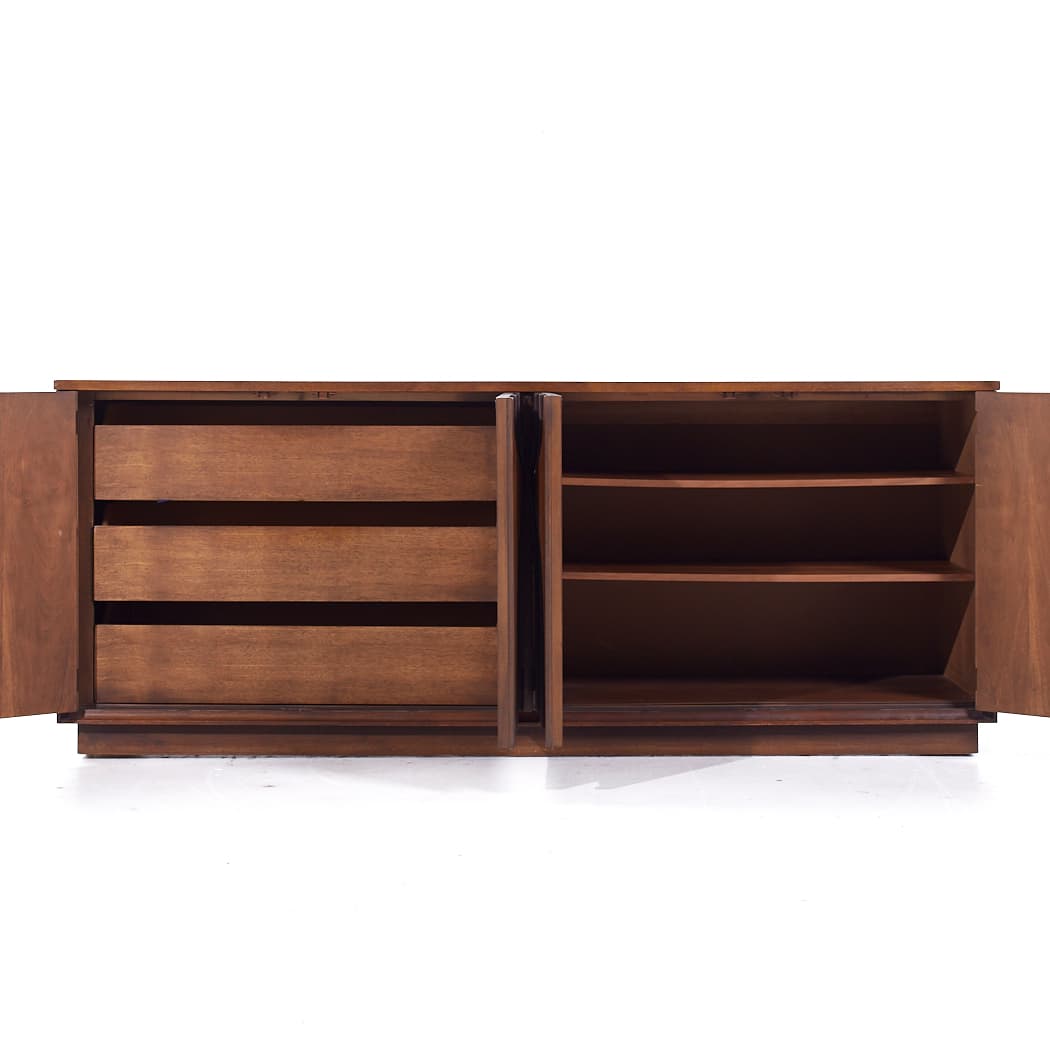
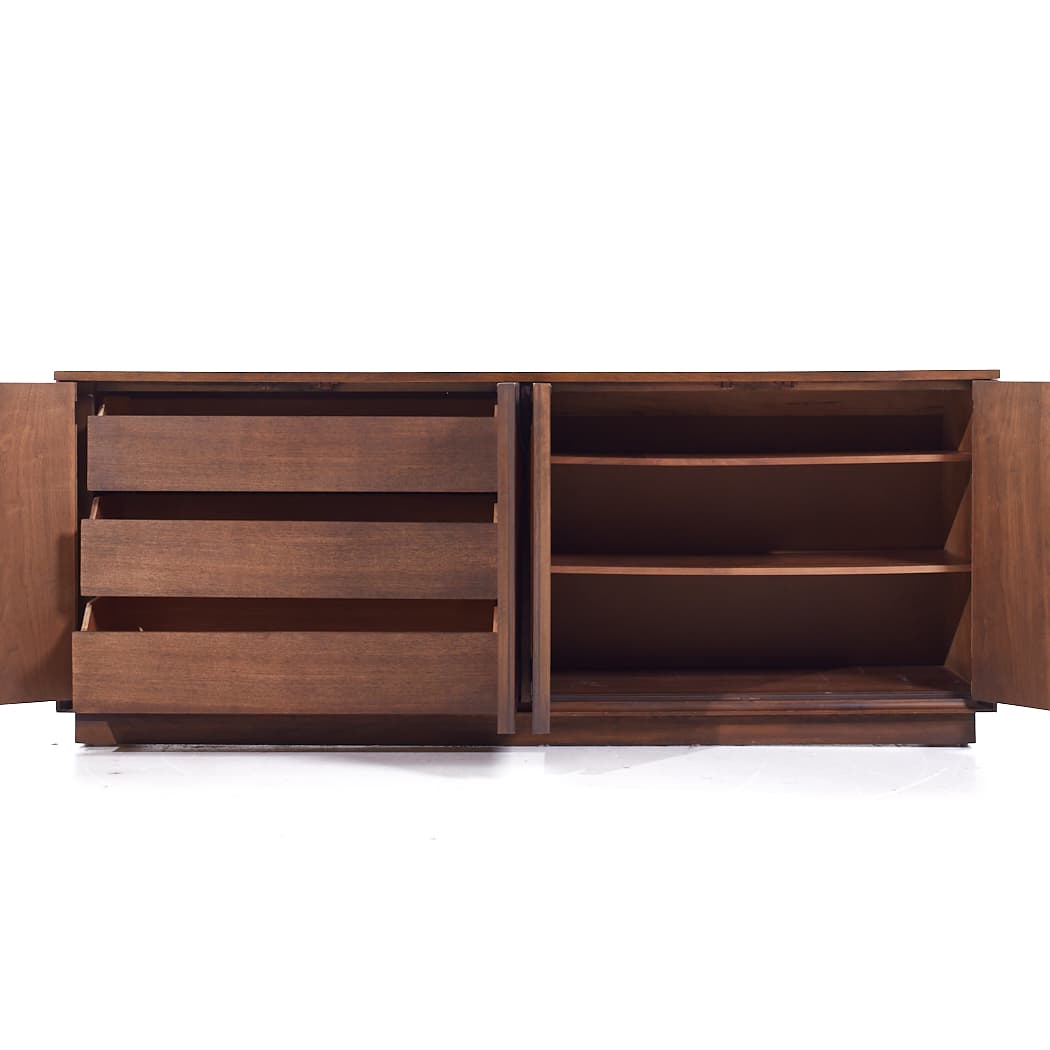
Use these photos to confirm your piece matches — each detail is a documented hallmark.
What it is
The Broyhill Brasilia Walnut Credenza is a credenza made by Broyhill (Broyhill Premier), part of the Brasilia line. The line is named for Brasilia, the modernist capital city of Brazil, whose civic architecture inspired the line's arches and colonnades. It is built from solid pecan and walnut with rosewood accents.
Designer, maker, and line
It was manufactured by Broyhill (Broyhill Premier). It belongs to the Brasilia line. Its factory model number is 6140-13 (the "Credenza Buffet"), 60 x 19 x 31 in.; 3 drawers, 4 doors.
Design and history
Brasilia was introduced by Broyhill in 1962 as part of its upper-tier Broyhill Premier range. Its designers drew directly on the architecture of Brazil's then-new capital, Brasilia -- the Palace of the Dawn and the city's civic buildings -- translating those arches and colonnades into the line's panels, pulls, and silhouettes.
The line's signature elements were formally protected. Seven U.S. design patents -- all filed the same day, April 15, 1963, all naming Melbourne F. Smith, Jr. as inventor and assigned to Broyhill Furniture Factories of Lenoir, North Carolina -- cover the recessed arch pull (Des. 196,833), the single- and double-arch panels (Des. 196,731 and 196,732), the arched headboard (Des. 197,207), two table forms including the Cathedral pedestal base (Des. 199,315 and 199,316), and the room-divider deck (Des. 199,317).
Common misconception
Brasilia is often assumed to have been designed by the Brazilian architect Oscar Niemeyer. It was not. Niemeyer designed the buildings that inspired the line, but had no role in the furniture and no documented connection to Broyhill. The Brasilia furniture was designed in-house at Broyhill; the signature elements are credited in U.S. design patents to Melbourne F. Smith, Jr., of Lenoir, North Carolina.
How to identify it
Look for these Brasilia hallmarks:
- Recessed "knifed" arch door pulls; on some forms the raised arch panels themselves act as integrated pulls
- Repeating arch-and-colonnade panel motif drawn from the architecture of Brasilia, Brazil
- Tapered solid-wood legs
- Warm walnut and pecan tone with rosewood accents
Original 1960s Brasilia pieces use recessed ("knifed") pulls; the later Broyhill "Mardella" reissue uses surface-mounted pulls (per Broyhill's own account).
Confirm the piece from its label or stamp — see Marks, labels, and stamps below.
Marks, labels, and stamps
Broyhill pieces carry a paper label, foil badge, ink stamp, and branded/burned mark on the back panel, the underside, drawer bottoms, and inside or on the side of the top drawer.
- Upper-line pieces read "Broyhill Premier"
- A style/group number is usually present (the credenza is 6140-13)
The word "Brasilia" often does not appear on the label; the line is identified from the arch carving, not the tag.
The primary 1963 Broyhill Premier catalog lists finishes by descriptive name and shows no encoded date or plant code. The collector reading that "the first two digits are the year" is interpretation, not a documented Broyhill key.
What it's worth
Limited data available for this section.
In our own transaction history we have handled 2 examples of this piece, so what follows is our experience, not a market-wide appraisal. As restored retail, results were in the range of about $4,246–$5,744. A fast, as-is dealer offer for a comparable piece typically sits well below that, nearer $500 — the gap reflects restoration value-add and the speed of a quick sale. Condition, originality, and restoration quality move these figures substantially.
These are market ranges, not an offer. Actual value depends on condition, originality, restoration quality, provenance, timing, and local demand.
Materials and finishes
Exposed woods are solid pecan and walnut, accented with rosewood. Case surfaces use walnut veneer over hardwood cores. Drawers run on metal "Broy-Glides" drawer glides and nylon floor glides. Original and refinished surfaces both appear; refinishing can affect value versus an all-original example.
Years of production
Introduced to market in August 1962 (documented at the Hecht Co., Washington, D.C.); production is reported to have continued until about 1970, when Broyhill changed ownership. It was made in Lenoir, North Carolina.
Dimensions and variations
The Credenza Buffet (6140-13) measures 60 in wide, 19 in deep, and 31 in high. Brasilia was a broad line, so related forms (dressers, credenzas, tables, room dividers) share the motif at different sizes; measurements can vary slightly across production runs.
Original retail pricing (period)
Period advertising documents original retail prices for the line (Julius Lansburgh Furniture, Evening Star, July 24, 1963, p.26):
- Credenza, 60 x 19 x 31 in.: $169.95 (1963)
- 9-drawer triple dresser: $155.95 (1963)
- Dining side chair: $27.95 (1963)
Advertised retail prices from period Washington, D.C. newspaper advertisements. These are historical figures for context, not a current valuation.
Desirability and collector interest
Limited data available for this section.
Demand is generally driven by condition, originality, and overall presentation. Refinishing, replaced hardware, and structural repairs tend to reduce desirability.
How long it typically takes to sell
In curated retail, comparable pieces have taken around 9 days to sell on average. A quick dealer sale typically closes in days to a couple of weeks. Local marketplaces (Facebook Marketplace, Craigslist) usually take weeks to months. Curated ecommerce (1stDibs, Chairish) can take weeks to a year or more. Price, presentation, location, and demand all affect speed.
Condition and restoration notes
Originality drives value on pieces of this age. Veneer chips, water rings, and sun-fading of the wood are common and worth checking for. Because case surfaces are veneered, inspect edges and tops for lifting or evidence of prior refinishing. Original hardware and drawer glides help confirm an all-original example; replaced hardware and refinishing both affect value.
Documented sources
Every fact on this page traces to a primary or period document. These are the sources — verify them yourself.
- USPTO
Assignor 'Broyhill Furniture Factories, Lenoir, N.C.' on the verified Brasilia design patents; corroborated by 'Lenoir, a division of Broyhill' labels.
- CATALOG
60 x 19 x 31 in., 3 drawers / 4 doors — 1962 factory catalog form 6140-13, corroborated by the 1963 Lansburgh credenza ad.
- CATALOG
Label types/locations Tier-2 corroborated (collector composite + weekand.com). Named-finish / no-date-code finding is Grade-A from the primary Broyhill Premier Saga 1963 catalog.
- PERIOD AD
Grade-A period source (Evening Star 1962-08-02, Hecht Co. feature) plus manufacturer corroboration.
- PERIOD AD
P.J. Nee ad, Evening Star 1963-02-06 p.57: solid pecan blended with walnut, rosewood accents, metal 'Broy-Glides'. Julius Lansburgh ad: 'walnut lightly accented with rosewood.'
- PRESS
Misconception pair: correction corroborated across independent editorial sources and the period record; the Niemeyer attribution is the widely-repeated lore. Smith authorship is Grade-A from the verified patents.
Frequently asked questions
Who designed the Broyhill Brasilia line -- was it Oscar Niemeyer?
What is the Broyhill model number for this Brasilia credenza?
How can I identify a genuine Broyhill Brasilia piece?
When was Broyhill Brasilia made?
What wood is Broyhill Brasilia made of?
Where was Broyhill Brasilia made?
Have a Broyhill Brasilia Walnut Credenza to sell?
Send a few photos and Modern Hill — our anchor dealer — will make you an instant cash offer on pieces like this, often same day. If it's not one we're buying right now, it won't get an instant offer, but we'll present it to vetted dealers in your area through the SellMCM match system and work to drum up an offer. Sellers never pay.
- No scams or random buyers
- Vetted dealer buyers only
- Sellers never pay
- We monitor the whole process
This is a reference & valuation page, not a listing. SellMCM does not sell this item, hold inventory, or handle payment or pickup — value figures are educational ranges from our own transaction history.